
Copeia Abstract / DPhG-Jahrestagung 2026
Real-world dosing patterns of cannabis extracts and dronabinol in routine medical care: data from the Physicians Experience Platform
Real-world dosing patterns of cannabis extracts and dronabinol in routine medical care: data from the Physicians Experience Platform
A. Landschaft (1,2),A. Ihlenfeld (2), T. Herdegen (3)
Information Services Department, Boston Children’s Hospital, Boston, MA 02115
Copeia GmbH, Bergisch Gladbach, Germany
Institut für Experimentelle und Klinische Pharmakologie, Universitätsklinikum Schleswig-Holstein, Kiel, Germany
DPhG-Jahrestagung 2026 · 21.–24. September Regensburg
Background
Cannabis extracts and dronabinol are increasingly used for chronic, difficult-to-treat symptoms; however, practical guidance on dosing in routine clinical care remains limited.
Uncertainty regarding typical THC daily doses, interindividual variability, and the potential relevance of body weight or body mass index (BMI) may contribute to prescriber uncertainty and inconsistent titration.
Objective: To describe real-world oral THC dosing patterns documented in the Physicians Experience Platform (PEP) and to examine associations between oral THC dose, body weight, and BMI.
Copeia Physicians Experience Platform (PEP)
The Physicians Experience Platform is a structured real-world database of physician-documented cannabis-based treatments in routine clinical care.
Standardized, interactive, multistep case documentation includes indications and symptoms, cannabis-based medicines, concomitant medication, dosing and dose changes, adverse effects, and effects on quality of life.
Data are entered exclusively by physicians via DocCheck-protected access. All cases are assessed according to predefined inclusion criteria.
Methods
Retrospective, descriptive real-world analysis of structured, physician-documented cases from the Copeia Physicians Experience Platform.
Of 435 documented cases, 318 cases with an oral THC daily dose >0 mg/day were included.
Mean age in the overall documented cohort (n = 435) was 55.9 years, and 62.1% were female.
Body weight and BMI were available for 253 cases.
Absolute oral THC daily dose and doses normalized to body weight and BMI were analyzed.
Descriptive statistics included mean, median, interquartile range (IQR), percentiles, and coefficient of variation (CV = SD/mean).
Associations of oral THC daily dose with body weight and BMI were assessed using Pearson and Spearman correlations.

Clinical interpretation
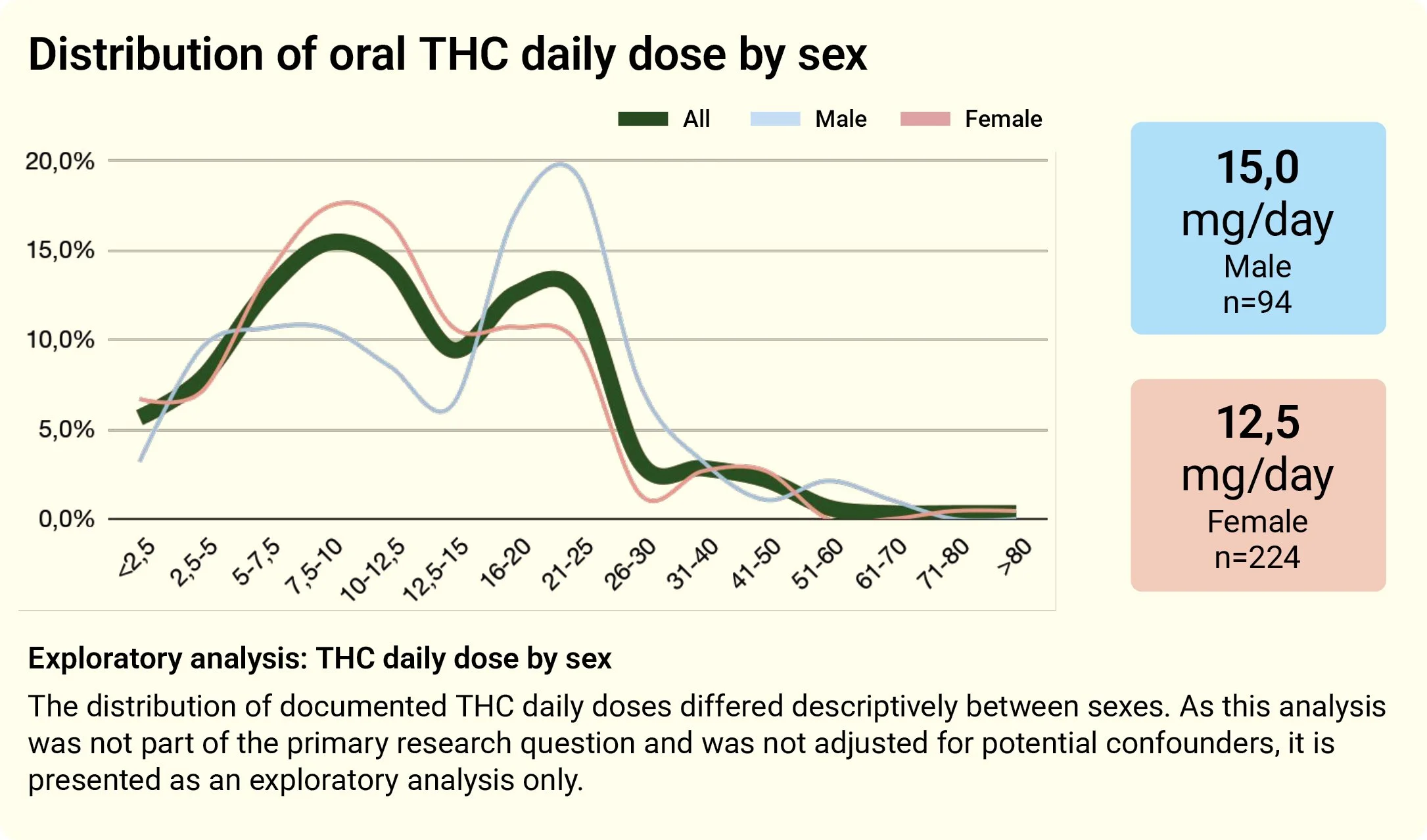
Oral THC doses clustered in the low tens of milligrams per day, with a median of 12.5 mg/day and a mean of 14.9 mg/day.
The observed dosing range is consistent with the approximately 15 mg THC/day reported for cannabis extracts, dronabinol, and nabiximols in the German nationwide accompanying survey on medical cannabis.
Pearson and Spearman correlations indicated negligible associations of oral THC daily dose with both body weight and BMI.
Normalization to body weight or BMI did not reduce interindividual dose variability.
These findings support individualized titration guided by clinical response and tolerability, rather than simple weight- or BMI-based dosing algorithms.
As a retrospective, descriptive real-world analysis without a control group, the study does not allow causal inference. Selection bias, heterogeneity in indications and treatment settings, and unmeasured confounding cannot be excluded.
Data update: Following abstract submission, a final data review was performed. The updated analysis includes 318 cases with a documented oral THC daily dose >0 mg/day and 253 cases with complete anthropometric data. The main findings and conclusions remain unchanged from the submitted abstract.
Conclusion
Real-world oral THC doses documented in the Physicians Experience Platform clustered in the low tens of milligrams per day, with considerable interindividual variability.
Neither body weight nor BMI showed a meaningful association with documented oral THC daily dose, and normalization to either parameter did not reduce dose variability.
These findings provide no empirical support for weight- or BMI-based oral THC dosing and support individualized titration guided by clinical response and tolerability.
Prospective studies should investigate which clinical factors may better predict individual oral THC dose levels.
Acknowledgments
The authors thank the physicians who contributed anonymized case documentation to the Physicians Experience Platform (PEP), operated by Copeia GmbH.
This publication was supported by Aurora Deutschland, Four 20 Pharma, and Tilray Deutschland.

PEP : Physicians Experience Platform
Kasuistiken suchen, vergleichen oder Fallbeispiele eingeben
If you would like to learn more about Copeia, have questions or suggestions, please contact us by email and we will get back to you as soon as possible. We look forward to hearing from you.
Your Copeia team
Copeia’s digital health solutions evolve personalised treatment of cannabis patients
Copeia combines expertise from international cannabinoid research with practical knowledge of doctors, patients, pharmacies and producers.
Copeia is a software company based in Cologne and Berlin that develops AI-based products and workflow solutions to support medical cannabis care.